How to Measure Yourself for a Flawless Custom Suit
The Difference Between a Good Suit and a Great One Starts with Measurements
Custom suit perfect measurements are the foundation of any well-fitted suit — and getting them right is simpler than most men think.
Here are the key measurements you need for a custom suit:
| Area | What to Measure |
|---|---|
| Neck | Around the base, at collar height |
| Chest | Fullest part, under the arms |
| Shoulders | Bone to bone across the back |
| Sleeve | Shoulder crown to wrist knuckle |
| Waist | Where you wear your belt |
| Stomach/Belly | Widest point above the belly button |
| Hips | Fullest part of the seat |
| Jacket Length | Base of neck to thumb knuckle |
| Inseam | Crotch to desired hem |
| Outseam | Waistband to floor |
| Thigh | Widest point around the thigh |
| Wrist | Around the fullest part |
The entire process takes less than 10 minutes with a tape measure and a friend.
Off-the-rack suits are built for an average body that most men don't have. Shoulders that fit may mean sleeves that are too long. A chest that fits may mean a waist that billows. No matter how good the fabric, a poor fit undermines everything.
A custom suit eliminates that compromise — but only if the measurements are accurate.
I'm Donald Carlson, founder of Tweeds Custom Suits, and I've spent decades handling fine menswear — first in my family's dry-cleaning business, then building Tweeds into Florida's premier destination for custom suit perfect measurements and made-to-measure tailoring. In the guide below, I'll walk you through exactly how to measure yourself for a flawless result.
Common custom suit perfect measurements vocab:
Why Custom Suit Perfect Measurements Outshine Off-the-Rack Sizing
When you walk into a department store, you are greeted by "standardized sizing." These numbers—like a 40R or a 34W—are based on a mathematical average of thousands of men. The problem? Almost no one is actually "average." We all have unique anatomical quirks: one shoulder might sit slightly lower than the other, or our posture might lean forward.
Off-the-rack suits utilize "block patterns." If you have an athletic build with broad shoulders and a narrow waist, a standard jacket that fits your chest will likely billow like a sail around your midsection. Conversely, if you have a bit of a "dad bod," a jacket that buttons comfortably might have shoulders that overhang your natural frame by two inches.
The best bespoke suit Orlando has to offer for dapper gents focuses on anatomical precision. When we take custom suit perfect measurements , we aren't just looking at length and width; we are analyzing posture and shoulder slope. These nuances dictate how the fabric drapes. A suit with poor measurements restricts movement—you’ll feel the fabric pull across your back when you reach for your steering wheel or phone. A custom suit, however, moves with you, acting as a second skin.
Essential Tools and Preparation for Your Fitting
Before you start pulling the tape, you need to set the stage. Accuracy is a game of millimeters, and poor preparation is the fastest way to end up with a suit that doesn't fit.
The Toolkit
- Cloth Tape Measure : Do not use a metal construction tape. You need a flexible tailor’s tape that can contour to your body.
- A Friend : While you can measure some parts yourself, you cannot accurately measure your own shoulders, back width, or sleeve length. You need an extra set of hands.
- Notepad/Phone : To record your numbers immediately.
- Full-Length Mirror : To ensure the tape stays level and horizontal around your body.
The Preparation
- Wear Form-Fitting Clothing : Measuring over a bulky hoodie or baggy jeans will add fake inches to your frame. Wear a well-fitting t-shirt or a dress shirt and thin trousers.
- Empty Your Pockets : Phones, wallets, and keys distort your hip and thigh measurements.
- Remove Your Shoes : This is crucial for accurate inseam and outseam calculations.
- Stand Naturally : Don't suck in your gut or puff out your chest like a superhero. If you don't stand naturally now, the suit won't feel natural later.
For those buying your first suit, the tape measure doesn't lie. Be honest with your posture and build to ensure the final garment is comfortable for the "real" you.
Step-by-Step Guide to Jacket and Shirt Measurements
The jacket is the centerpiece of your ensemble. It’s where the most complex engineering happens, from the collar roll to the sleeve pitch.
Neck and Shoulders
Start with the Neck Circumference . Wrap the tape around the base of your neck where the collar sits. Leave enough room for one finger to slide between the tape and your skin—this ensures you can breathe once the top button is fastened.
Next is Shoulder Width . This is a "bone-to-bone" measurement. Find the prominent bone at the edge of your shoulder (the acromion process) and measure across the natural curve of your back to the same point on the other side. This defines the "crown" of the sleeve.
Jacket Length and Armholes
Jacket Length is often a matter of style preference, but the classic rule is to measure from the base of the neck down to the point level with your thumb knuckle. This ensures the jacket covers the base of your crotch for a balanced silhouette.
| Style | Length Description | Best For |
|---|---|---|
| Short | Hits just above the seat | Men under 5'8" |
| Regular | Covers the seat fully | Average height |
| Long | Extends slightly past the seat | Men over 6'2" |
Armhole Height is a hidden secret of high-end tailoring. Higher armholes allow for a greater range of motion without the entire jacket lifting when you raise your arms.
Achieving Custom Suit Perfect Measurements for the Torso
When measuring the Chest , wrap the tape under your armpits and across the fullest part of your chest (usually across the nipples). Keep the tape snug but not tight. Use the "three-finger rule": you should be able to fit three fingers inside the tape for a comfortable, breathable fit.
For the Stomach/Belly , find the widest point. This is usually around the belly button. Do not suck in! If you plan on eating dinner in this suit, you need to measure your stomach in its relaxed state. We offer mobile fittings across Florida to help you nail these tricky torso dimensions in person.
Sleeve and Shoulder Precision for a Custom Suit Perfect Measurements
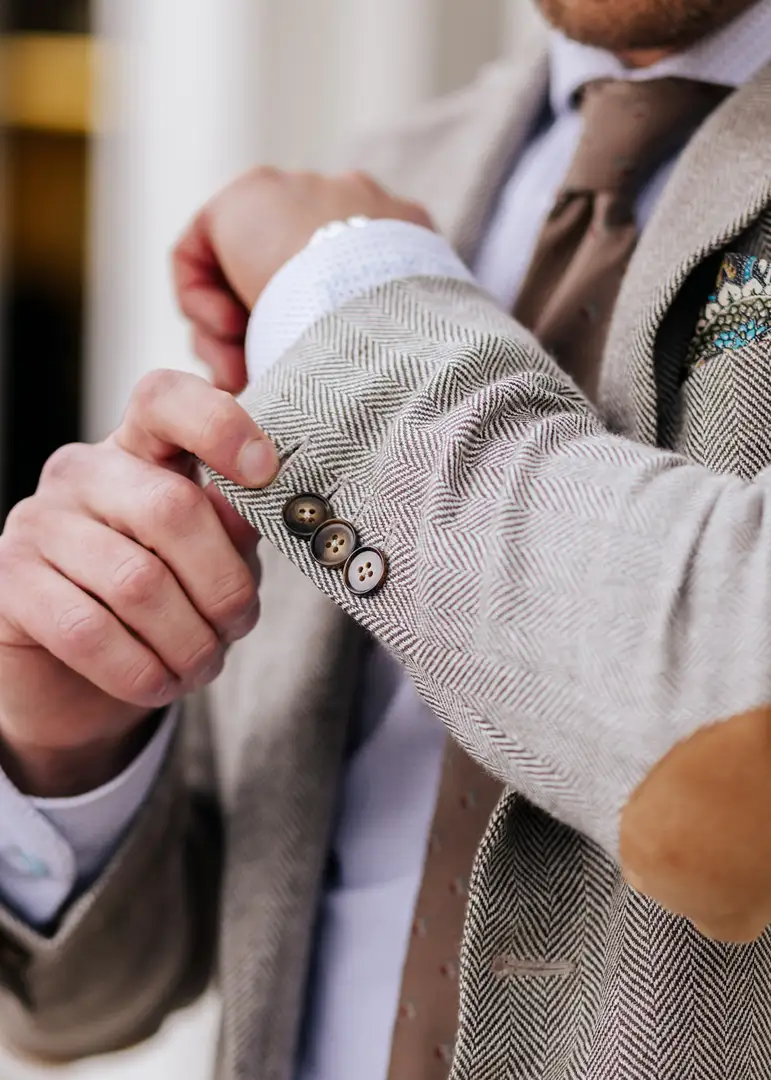
The Sleeve Length (or Crown to Cuff) is measured from the shoulder bone down to the knuckle of your thumb. However, the actual jacket sleeve should end at the large bone of your wrist. This allows for roughly 1/4 to 1/2 inch of shirt cuff exposure—the hallmark of a well-dressed man.
Don't forget the Bicep and Wrist . Measure the fullest part of your bicep with your arm relaxed at your side. For the wrist, measure the circumference just above the bone. These details prevent the sleeves from looking like "wizard sleeves" or being so tight they restrict blood flow. Check out our fitting appointment video to see how we handle different arm types.
Measuring for the Perfect Pair of Custom Trousers
Suit pants are not jeans. They sit higher on the waist and require a different approach to measurement to ensure they drape cleanly without "pooling" at your shoes.
The Waist and Seat
The Natural Waistline for suit trousers is usually about two fingers below the belly button—higher than where most modern men wear their denim. Wrap the tape where you would normally wear your belt.
The Seat (Hips) measurement is one of the most important. Wrap the tape around the fullest part of your buttocks. If this measurement is too tight, the pockets will flare open, and you risk a "blowout" when sitting down. We discuss these nuances in our guide on how to handle your showroom visit.
Thigh and Knee
Measure the Thigh at its widest point, just below the crotch. For the Knee , measure the circumference of your knee while standing straight. These measurements allow us to create a tapered silhouette that follows the natural line of your leg without being restrictive.
Inseam, Outseam, and the Ideal Pant Break
The Inseam is the distance from the crotch to your desired hem. The Outseam is measured from the top of the waistband down the outside of the leg to the floor.
The "Break" refers to how much the trouser fabric folds when it hits your shoe:
- No Break : The hem just grazes the top of the shoe. Very modern and clean.
- Quarter/Half Break : A slight dent in the fabric where it meets the shoe. The classic, timeless choice.
- Full Break : A deep fold. Generally avoided in modern custom tailoring as it can look sloppy.
When you suit up without the stress, our fit guarantees ensure that if the break isn't exactly how you pictured it, we make it right.
Common Pitfalls to Avoid During the Measuring Process
Even with a guide, it’s easy to make mistakes that lead to a "franken-suit." Here are the most common errors we see:
- "Cheating" the Tape : Many men instinctively suck in their stomach or stand unnaturally straight. This leads to a suit that only fits when you are posing in front of a mirror, not when you are living your life.
- Adding "Ease" Yourself : Some clients add an extra inch to their measurements "just in case." Don't do this! Our master tailors already account for comfort and movement based on your raw body measurements.
- Measuring Alone : You simply cannot keep the tape level across your back by yourself. If the tape tilts, the measurement is wrong.
- Bulky Clothing : We can't stress this enough—measure in light, form-fitting clothes.
- Mixing Units : Ensure you are using inches or centimeters consistently. In the U.S., we almost exclusively use inches for custom suit perfect measurements .
If you're unsure, it's always best to visit the best places to get measured to ensure professional accuracy.
Frequently Asked Questions about Custom Suit Fitting
How long does the measurement process take?
Our specialized system is designed for efficiency. Once you have your tools and a friend ready, the actual measurement process takes less than 10 minutes . The preparation (emptying pockets, removing shoes) takes about two minutes, and the recording takes the rest. You can find more details in our FAQs.
Can I take my own measurements without help?
Technically, yes, but we don't recommend it for a full suit. You can handle the waist and thigh, but the shoulders and sleeve pitch require a second person to ensure the tape is positioned correctly over your anatomy. Accuracy risks increase by 50% when measuring solo.
What if my measurements change before the suit is finished?
Life happens. Most custom suits take 4–8 weeks to produce. If you experience minor weight fluctuations, our suits are built with "seam allowance," meaning a local tailor can easily let the waist in or out by about an inch. For more significant changes, we offer alteration support and final fittings to ensure the fit is still perfect upon delivery.
Conclusion
Achieving custom suit perfect measurements is the first step toward a wardrobe that reflects your success and personal style. At Tweeds Custom Suits, we combine the traditions of bespoke tailoring with a modern, personalized approach. Whether you are visiting one of our Florida showrooms in Miami, Orlando, or Tampa, or scheduling a mobile fitting in Charlotte or Atlanta, our goal is to provide a garment that makes you feel unstoppable.
A suit is more than just fabric; it’s an investment in your confidence. By following this guide, you’ve laid the groundwork for a flawless fit. Ready to see the difference for yourself? Schedule your fitting at Tweed's Suit Shop today and let us craft something truly yours.