Silk vs Bemberg: Choosing the right interior for your jacket
The Hidden Detail That Separates a Good Suit from a Great One
Silk lining for suits is a premium interior fabric choice that adds luxury, breathability, and a refined feel to any tailored jacket — but it comes at a cost.
Quick answer: Should you choose silk lining for your suit?
| Your Priority | Best Lining Choice |
|---|---|
| Maximum luxury and feel | Silk |
| Best value and durability | Bemberg cupro |
| Budget-friendly | Viscose rayon or polyester |
| Hot climate / breathability | Bemberg cupro or half-lining |
| Bespoke personalization | Silk (printed or plain) |
Most men never think about what's on the inside of their jacket. But the lining is the first thing you feel every time you put it on. It affects how the suit slides over a shirt, how it drapes on your body, and how comfortable you feel wearing it all day.
The choice between silk and synthetic alternatives like Bemberg cupro isn't just about cost. It's about what you want your suit to do for you.
I'm Donald Carlson, founder of Tweeds Custom Suits — I grew up surrounded by fine garments through my family's dry-cleaning business and have spent years helping clients choose the right silk lining for suits that match both their lifestyle and their standards. That hands-on experience is what shapes everything you'll read here.
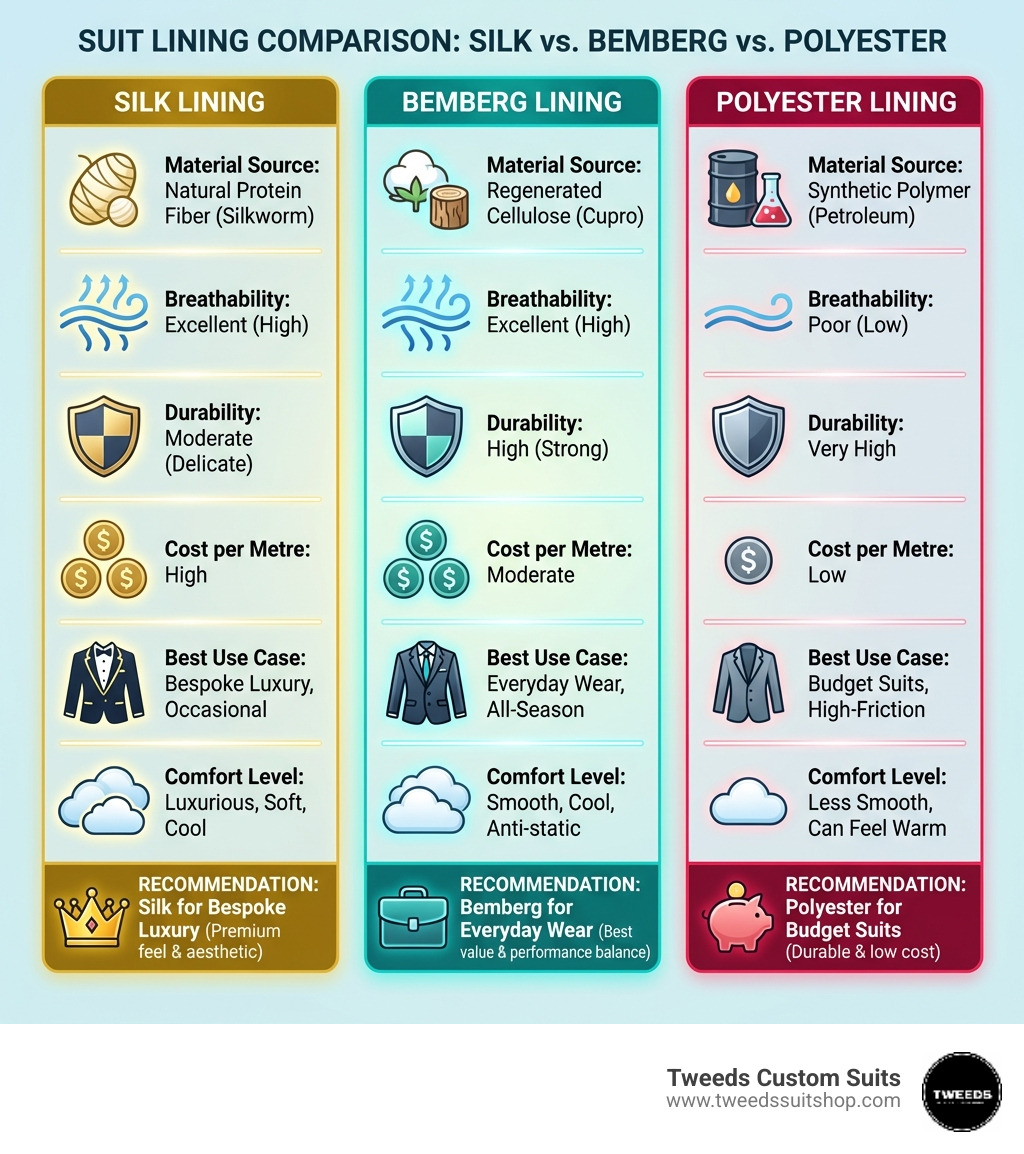
Understanding Silk Lining for Suits vs. Synthetic Alternatives
When we talk about the interior of a jacket, we are looking at the barrier between your shirt and the heavy wool of your suit. This layer serves several masters: it must be smooth enough to let the jacket slide on easily, breathable enough to prevent overheating, and durable enough to withstand the constant friction of your movement.
For decades, the gold standard in high-end tailoring has been silk lining for suits . However, the modern market is dominated by "semi-synthetics" and "synthetics." To make the right choice for your next custom commission at one of our Florida or Georgia showrooms, you need to know what these terms actually mean.
The Contenders: Bemberg, Rayon, and Beyond
- Bemberg Cupro: This is the most popular high-quality alternative to silk. It is a "regenerated cellulose" fiber made from cotton linter (the silky fibers surrounding the cotton seed). It breathes like cotton but feels like silk. In the tailoring world, Bemberg is a brand name that has become synonymous with quality cupro.
- Viscose Rayon (Ermazine): Often used by traditional Savile Row tailors, ermazine is a type of viscose made from wood pulp. It is slightly tougher than cupro and comes in a vast array of colors. It’s a reliable workhorse for everyday business suits.
- Polyester and Acetate: You will typically find these in off-the-rack suits. They are cheap to produce but are essentially plastic. They don't breathe, they trap heat, and they often have a "tinny" shine that looks inexpensive.
Bernstein & Banleys quality insights suggest that the biggest trend in the last 30 years is a move toward quality. As cheap manufacturing has flooded the market, discerning gentlemen are returning to natural and high-grade semi-synthetic linings to ensure their garments last.
Comparison Table: Lining Materials at a Glance
| Feature | Natural Silk | Bemberg Cupro | Polyester |
|---|---|---|---|
| Origin | Silkworm Cocoon | Cotton Linter | Petroleum |
| Breathability | High | Excellent | Low (Sweaty) |
| Durability | Moderate | High | High |
| Feel | Unmatched Luxury | Silky/Smooth | Slick/Plastic |
| Cost | $$$$$ | $$ | $ |
| Static | Low | Very Low | High |
Advantages of Silk Lining for Suits
Why would someone pay a premium for silk? The reasons are rooted in biology and tradition.
- Natural Fiber: Silk is a protein fiber. Like your own skin, it reacts to your body. It is naturally hypoallergenic, making it the best choice for clients with sensitive skin who might find synthetics irritating.
- Temperature Regulation: Silk is an incredible insulator. It keeps you warm in the winter and, due to its moisture-wicking properties, relatively cool in the summer.
- Aesthetic Depth: There is a "glow" to silk that synthetics cannot perfectly replicate. Whether it’s a matte Habotai or a lustrous Twill, the way silk takes dye creates a richness of color that is immediately visible when you unbutton your jacket.
- Luxury Feel: There is a psychological component to luxury. Knowing that your jacket is lined with the finest material on earth changes how you carry yourself. It’s the difference between driving a car with a plastic dashboard versus one with hand-stitched leather.
The Performance of Silk: Breathability, Comfort, and Drape
A suit's performance is often measured by how it "hangs." The lining plays a massive role in this. If a lining is too heavy or stiff, it can fight against the exterior wool, causing ripples and bunching.
Moisture Wicking and Static
One of the most annoying aspects of cheap linings is static cling. We’ve all had that moment where a jacket sticks to our shirt or trousers. Silk lining for suits has naturally low static electricity. Furthermore, silk can absorb up to 30% of its weight in moisture without feeling damp, which is a lifesaver during a humid afternoon in Miami or Tampa.
Friction Levels
Interestingly, silk actually has higher friction than Bemberg cupro. While silk feels softer to the touch, Bemberg is often "slicker." This is why some expert tailoring advice from Permanent Style suggests that for a daily "beater" suit, Bemberg might actually be more practical for ease of donning and doffing. However, for a wedding suit or a "power suit," the tactile luxury of silk usually wins.
Weight Considerations: The 110g Standard
Most quality suit linings weigh in at approximately 110 grams per meter. This weight is the "sweet spot"—heavy enough to provide structure and hide the internal canvas and seams of the jacket, but light enough not to add bulk. Silk linings, particularly silk twills, hit this mark perfectly, providing enough "body" to help the jacket drape smoothly over your torso.
Types of Silk Fabrics and Design Choices
Choosing silk lining for suits isn't just about picking a color; it's about picking a weave. Each weave changes the "vibe" of the jacket interior.
Habotai, Twill, and Satin Silk Lining for Suits
- Silk Habotai (China Silk): This is a lightweight, plain-weave silk. It is very soft and has a moderate sheen. It's often used in lighter summer jackets. However, because it is so delicate, it isn't the best choice for tight-fitting jackets where the seams are under a lot of stress.
- Silk Twill: This is the king of linings. It features a diagonal ribbing (similar to denim but much finer). Twill is the most durable silk weave, making it the standard choice for high-end bespoke jackets. It holds its shape well and resists tearing at the armholes.
- Silk Satin/Charmeuse: If you want that high-gloss, liquid look, satin is the way to go. It is incredibly smooth, but be warned: it shows every snag and water spot. We usually recommend this for evening wear or tuxedos.
Color and Pattern: Tonal vs. Contrast
How should you style your lining? At Tweeds, we see two main schools of thought:
- The Traditionalist (Tonal): This involves matching the lining to the suit fabric. A navy suit gets a navy lining; a charcoal suit gets a charcoal lining. This is the safest, most elegant choice. It ensures the suit remains versatile for all occasions.
- The Individualist (Contrast/Pattern): This is where silk lining for suits really shines. Because silk takes prints so well, you can opt for bold paisleys, floral spirals, or even artistic reproductions.
Pro Tip for Pairings:
- Navy Suit: Try a deep purple or a rich burgundy lining.
- Brown Tweed: An olive green or burnt orange lining looks spectacular.
- Grey Suit: A sky blue or even a bold red lining can add a "hidden" pop of personality.
We often tell our clients in Charlotte or Jacksonville that a bold lining is like a secret for the wearer. You don't see it when the jacket is closed, but when you toss it over a chair or reach for your wallet, it reveals a flash of your personal style.
Frequently Asked Questions
When clients visit our showrooms in places like Fort Lauderdale or Nashville, they often have the same concerns about upgrading to silk. Here are the facts.
Is silk lining suitable for trousers and overcoats?
For trousers, we generally recommend a high-quality Bemberg or viscose half-lining (to the knee). Trousers undergo much more friction than jackets, and silk can wear out quickly in the seat and thighs.
For overcoats, silk is beautiful but delicate. If you are wearing your overcoat daily in a city like Rye, NY, a heavy viscose or a silk-wool blend might be more durable. However, for a formal "Crombie" style coat, a heavy silk twill is the ultimate luxury.
How much more expensive is silk than Bemberg?
The price gap is significant. Silk lining for suits can be at least 5 times more expensive than standard synthetics. While a meter of quality Bemberg might cost $10–$20, high-end Italian silk linings can range from $50 to over $200 per meter. For a standard jacket requiring about 2 meters of lining, this can add $100–$400 to the base cost of the garment.
Does silk lining affect the suit's drape?
Yes, positively. Because silk is a natural fiber with "give," it moves with the outer wool fabric better than a stiff polyester would. It helps the jacket mold to your body over time, whereas synthetic linings can sometimes feel like you're wearing a layer of paper inside your suit.
How do I care for a silk-lined suit?
Silk is sensitive to chemicals and heat. You should always take your silk-lined suits to a reputable dry cleaner (something I know a thing or two about!). Avoid over-pressing the jacket, as excessive heat can "burn" the silk fibers and cause them to become brittle and shatter over time.
Conclusion
Choosing the right interior for your jacket is the final step in creating a garment that is truly yours. While Bemberg cupro is a fantastic, durable, and breathable choice for the everyday professional, silk lining for suits remains the undisputed heavyweight champion of luxury.
If you are commissioning a suit for a milestone event—a wedding in Palm Beach, a gala in New Orleans, or a major boardroom presentation in Atlanta—silk offers a sensory experience that synthetics simply cannot match. It is an investment in how you feel, not just how you look.
At Tweeds Custom Suits, we pride ourselves on guiding you through these minute details. From the weight of the silk to the curve of the lapel, our family-owned business is dedicated to personalized craftsmanship and a perfect fit guarantee across all our 10+ showrooms.
Ready to feel the difference for yourself?
Book a fitting for a custom suit at one of our locations today and let us help you design a suit that is as impressive on the inside as it is on the outside.